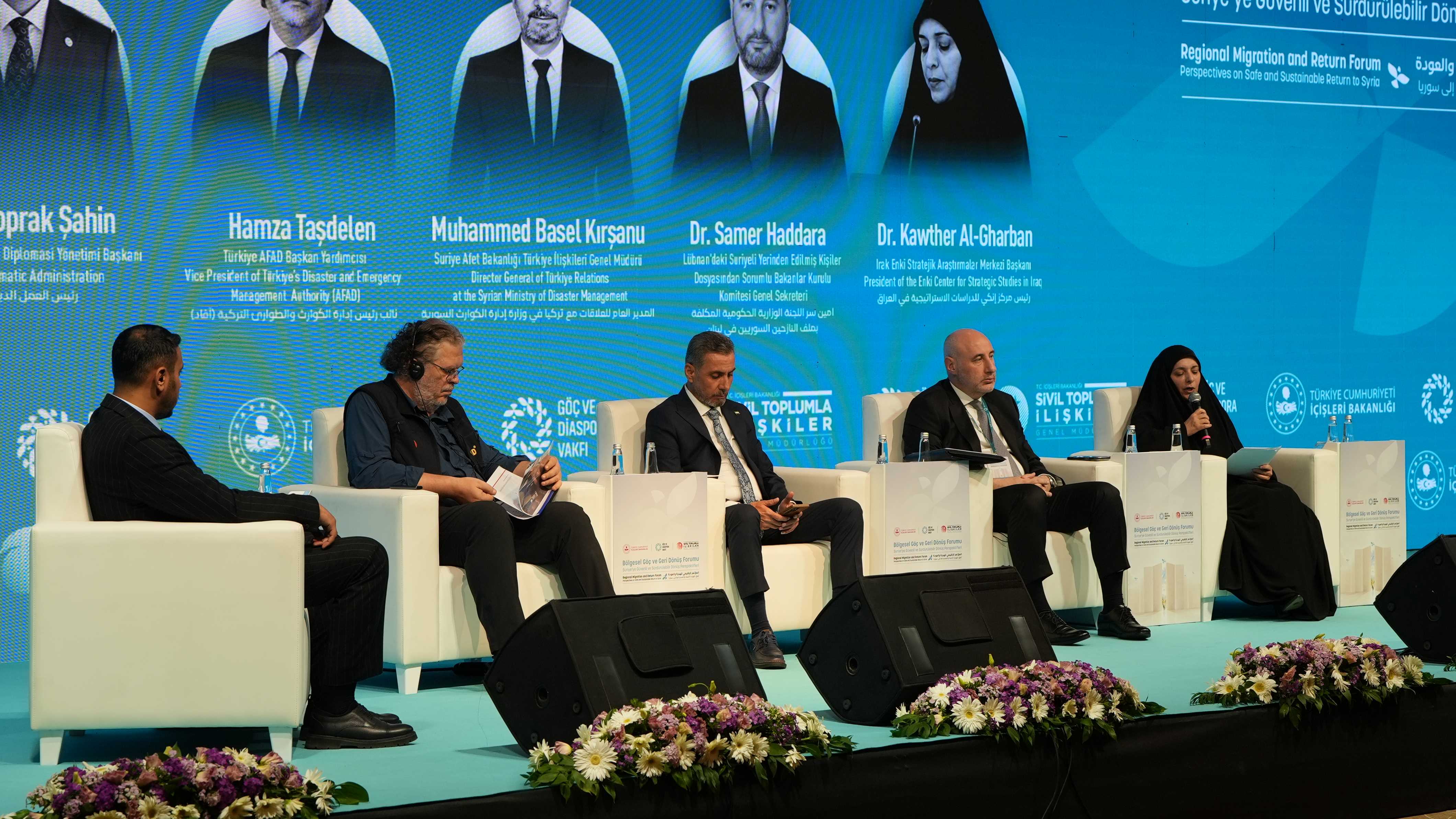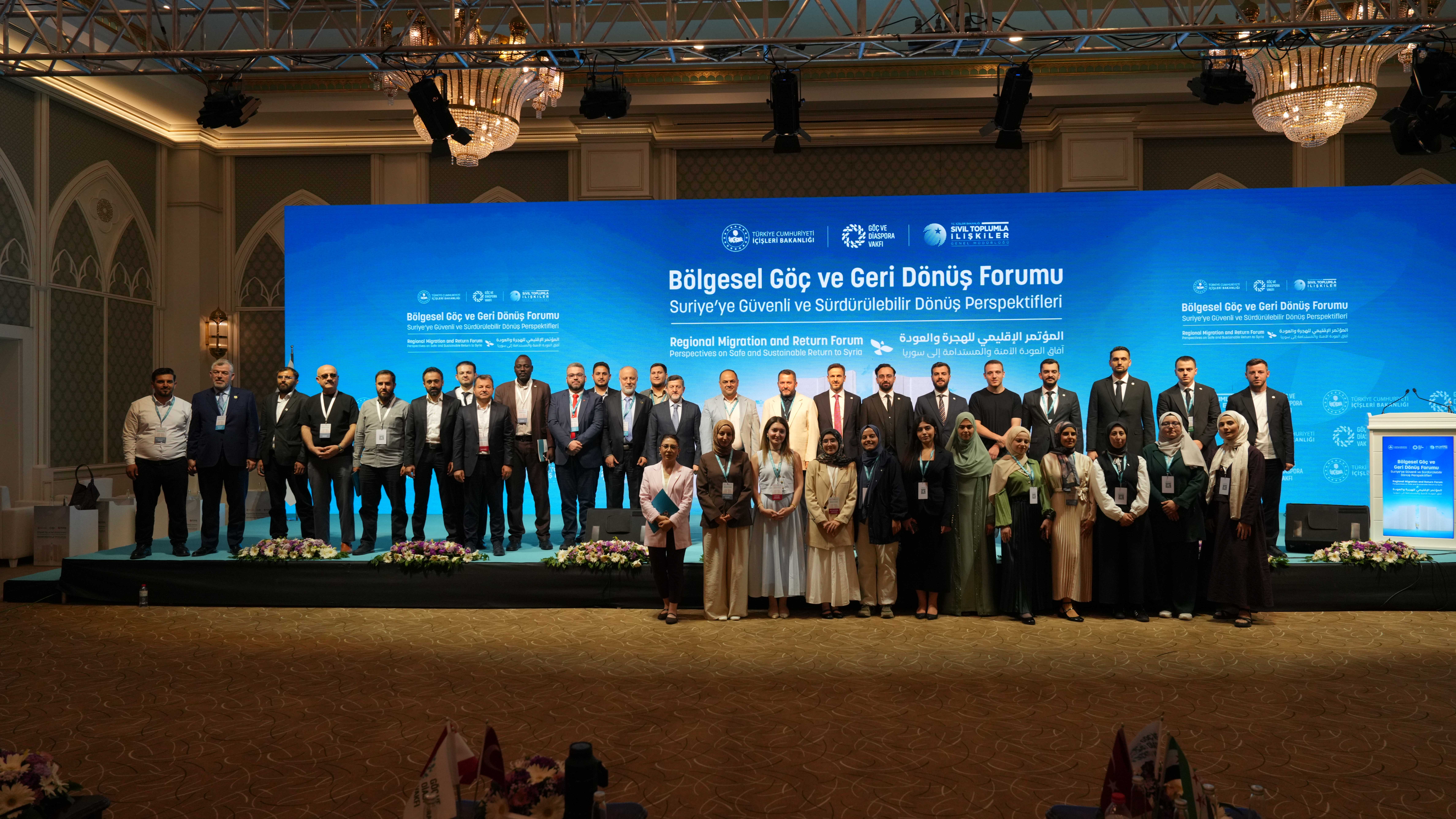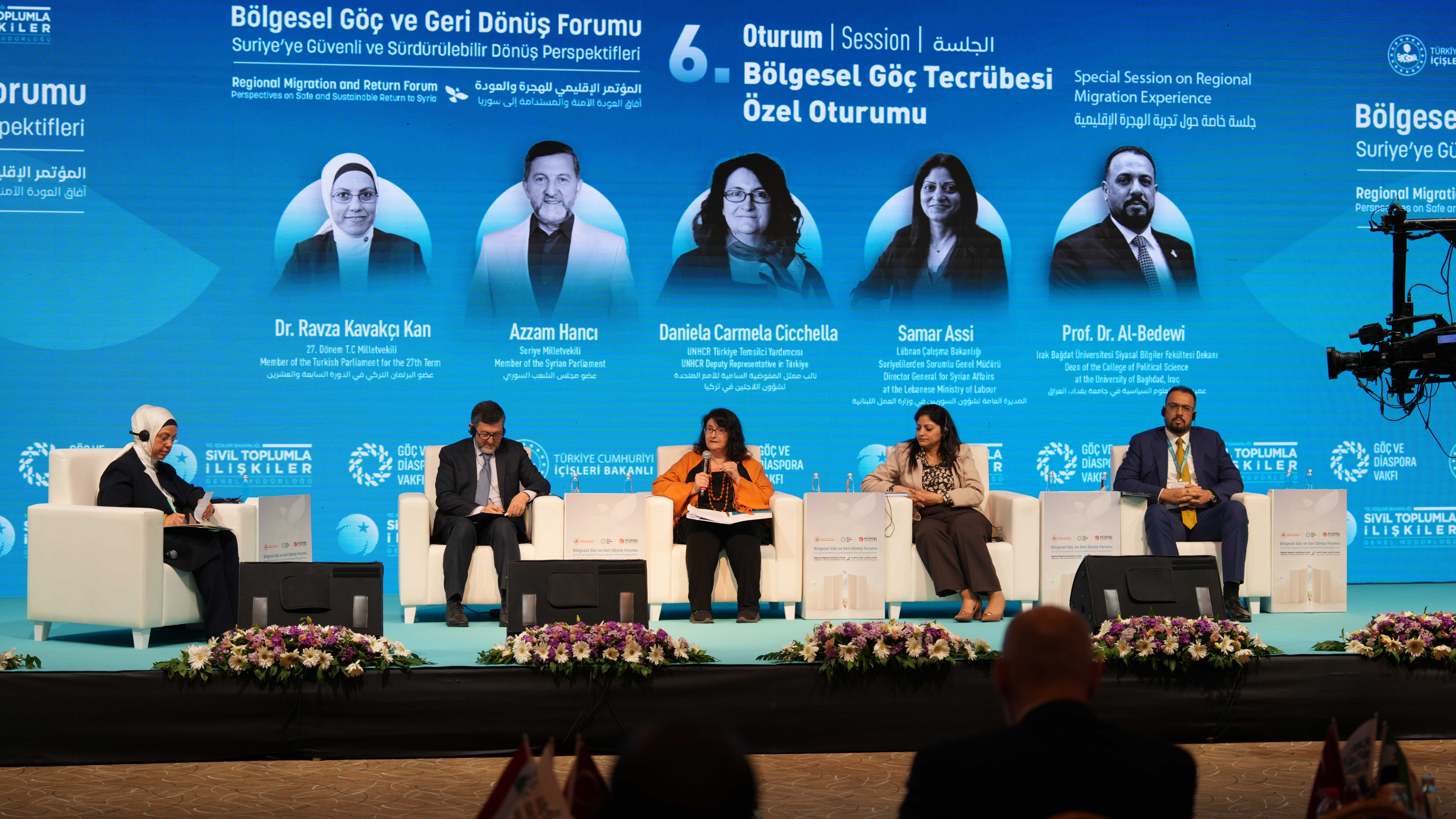
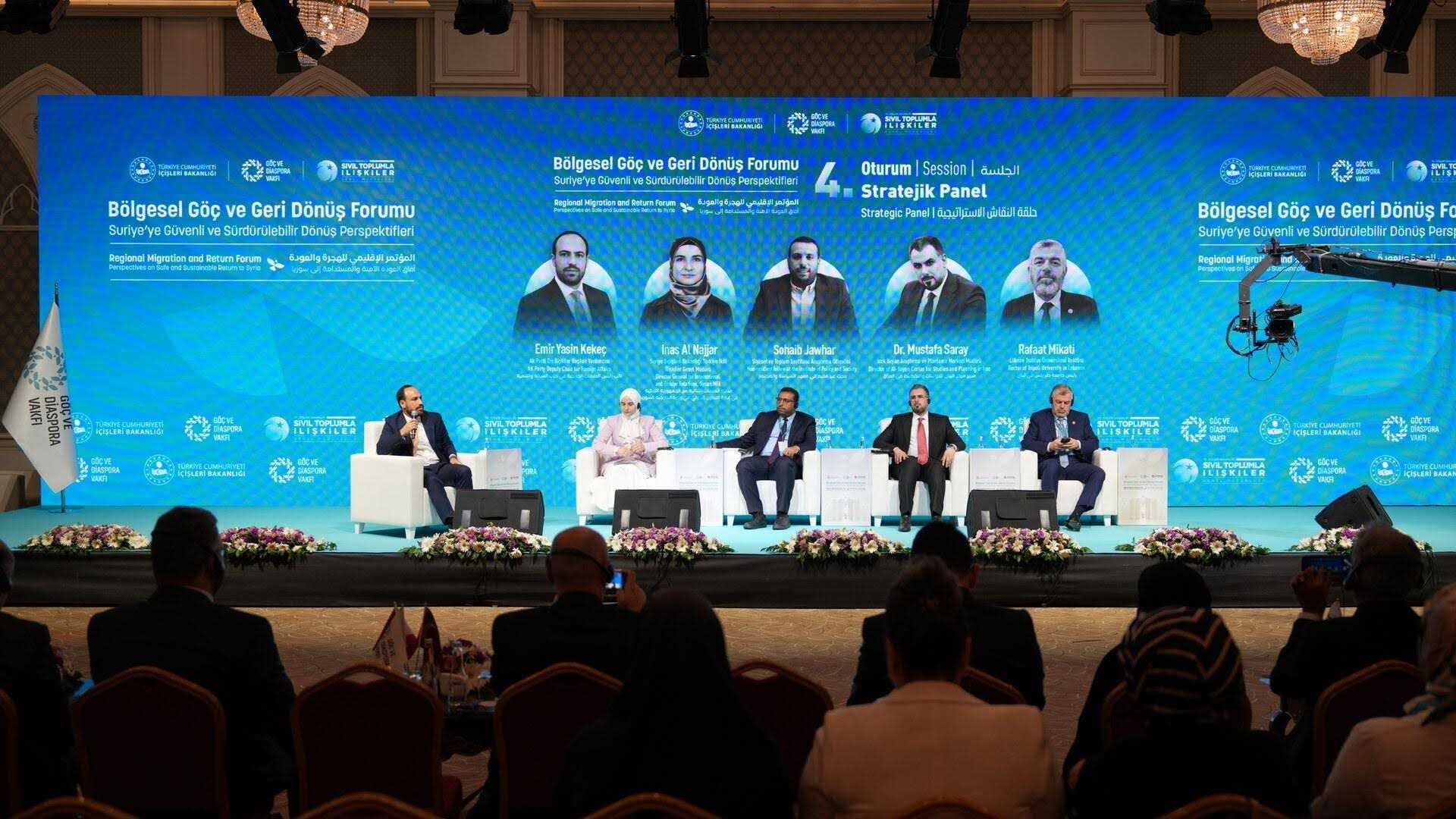
In the Strategic Panel held on the second day within the scope of the Regional Migration and Return Forum, reconstruction and the creation of safe living spaces in safe and sustainable return processes were addressed.
In the session moderated by AK Party Vice Chairman of Foreign Affairs Emir Yasin Kekeç; Inas Al Najjar, Director General of Turkey Bilateral Relations at the Syrian Ministry of Foreign Affairs; Sohaib Jawhar, Research Fellow at the Politics and Society Institute; Dr. Mustafa Saray, Director of the Iraqi Bayan Center for Planning and Studies; and Rafaat Mikati, President of Tripoli University in Lebanon shared their views.

In the panel, evaluations were made on infrastructure, housing, health, and education investments, as well as coordinated reconstruction processes.
Al Najjar: Return should be planned within the framework of a specific strategy

Emphasizing that return should be handled within the framework of a specific strategy, Inas Al Najjar, Director General of Turkey Bilateral Relations at the Syrian Ministry of Foreign Affairs, expressed that it should be taken into account that people who left behind their homes, property, and jobs when leaving their country will face a cost upon their return as well.
Stating that, according to World Bank data, there is a reconstruction need of approximately 200 billion dollars in Syria, Al Najjar noted that this is not a burden that the Syrian government can handle alone, and that a sharing of burden and responsibility together with neighboring and supporting countries is required. She expressed that the international support received so far has remained mostly at the level of declarations of intent, and that contributions such as the repair of schools and hospitals are not on a scale to constitute the infrastructure for return.
Stating that the return of vulnerable groups such as children, women, and the elderly should be supported primarily, Al Najjar expressed that initial incentives allowing their families to earn a living for the return of qualified personnel such as physicians, academics, engineers, and teachers would accelerate the process. She emphasized that Syrian youth raised in Turkey being familiar with Turkish language and culture forms a bridge that strengthens relations between the two countries, and that this accumulation should be evaluated as a long-term gain.
Underlining that return should be voluntary, Al Najjar stated that regulations facilitating round trips would accelerate the process; and that non-governmental organizations should be included in the process not merely as implementers, but as actors who identify needs in the field and provide feedback to policymakers.
Jawhar: Reconstruction is not just rebuilding buildings, but also institutions

Sohaib Jawhar, Research Fellow at the Politics and Society Institute, stated that a balance needs to be established between financial capacity and refugee hosting capacity in his country, but this balance has not yet been achieved. He relayed that, according to a report by a Beirut-based research center, the destruction Lebanon was subjected to exceeded 20 billion dollars, to which the financial crisis taking effect since 2019 was added.
Emphasizing that reconstruction does not merely mean building roads and buildings, Jawhar expressed that the main issue is the rebuilding of state institutions and capacities. He stated that addressing the shortcomings in electricity, water, education, and health services is also a matter of social security in Lebanon.
Jawhar emphasized that the problems in the region are not only the result of the last fifteen years, but of issues accumulated over decades; therefore, a solution will only be possible step-by-step within a specific plan and strategy. He expressed that regional actors acting together in this process and the negotiation diplomacy pursued by Turkey could be decisive.
Dr. Saray: Migration is not a burden, but a potential to be evaluated

Dr. Mustafa Saray, Director of the Iraqi Bayan Center for Planning and Studies, stated that the issue of migration should be handled not merely as a crisis, but as an issue that can be turned into an opportunity, expressing that Iraq has a unique experience as both a country of origin and destination for migration.
Emphasizing that refugees should be seen not as a point of weakness for the state, but as a pool of talent to be evaluated, Saray expressed that this potential could be mobilized with smart financing models and micro-credits. He stated that Syrians located in Iraq both contribute to the country they are in and transfer the experience they have gained upon their return to the reconstruction of their country.
He expressed that economic cooperation could be strengthened through the revival of mutual trade and support for projects such as energy pipelines and the development road; and in this direction, commissions enabling countries to benefit from each other's experiences and a joint regional fund focusing on specific investment areas could be established.
Referring to the relations between Iraq and Syria as well, Saray stated that the neighborhood and kinship ties between the two countries are strong, and there is a strong will to develop coordination in security, economic, and social fields, especially joint border security.
Rafaat Mikati: Academic return must also be safe

Rafaat Mikati, President of Tripoli University in Lebanon, built his speech on the concept of "academic return," relaying that their university accepted hundreds of Syrian students on full scholarships during the war period. He stated that some of the accepted students were graduates from Damascus and Aleppo universities, while others were students whose education was left incomplete.
Expressing that this support was seen as a humanitarian and moral responsibility, El Mikati relayed that graduated students today undertake duties such as rectorates and deanships in Syria, some are academics in Turkey, and some contribute to the establishment of new educational environments by teaching in schools.
Referring to the bureaucratic obstacles faced by students, El Mikati stated that detailed transcripts year by year are requested in diploma equivalence processes; however, these documents cannot be accessed as many schools were destroyed in the war. He expressed that not being able to enter the equivalence process without a residence permit makes the process even more complicated.
Emphasizing that not renewing the residence of a student whose education continues effectively means forced migration, El Mikati said that residency should not be turned into a tool of pressure. For a sustainable academic return, he proposed establishing a joint committee between the education ministries of Syria and Lebanon and resolving equivalence processes definitively within a specific timetable.
El Mikati also relayed that they organized an international conference focusing on the quality of education during war periods; and that they initiated a study to archive the educational support provided during migration periods, stating that they are open to cooperation with the Migration and Diaspora Foundation in this field.
Emphasis on regional cooperation
Making an evaluation at the closing of the session, Kekeç emphasized that the problems of the region should be solved by regional actors, expressing that in countries where stability is achieved, the diaspora returns to lead economic development, and that the Somalia example clearly demonstrates this.
Stating that relations between countries had been conducted through the security bureaucracy for a long time, while civil and academic consultation channels strengthened late, Kekeç said that the forum contributed to filling this gap. He expressed his wish for the forum to be held in the capital of one of the participating countries next year.
Presentation of appreciation to the contributing speakers

Following the panel, Murat Şahin, Head of Financial Affairs and Organization Management at the Migration and Diaspora Foundation, presented thank-you gifts to Inas Al Najjar, Sohaib Jawhar, Dr. Mustafa Saray, and Rafaat Mikati for their valuable contributions to the forum.
Roundtable workshop held after the panel

In the Roundtable Workshop held within the scope of the Regional Migration and Return Forum, strategic approaches towards strengthening social cohesion and local stability after return were addressed.
In the workshop held with the participation of strategic think tanks operating in the field of migration and integration; consultations were held on the integration of the returning population with local people, mediation mechanisms for protecting property rights, and academic proposals to support the sustainability of social peace.
Bringing together experts from different institutions, the workshop made a significant contribution to the exchange of ideas that will strengthen regional cooperation.