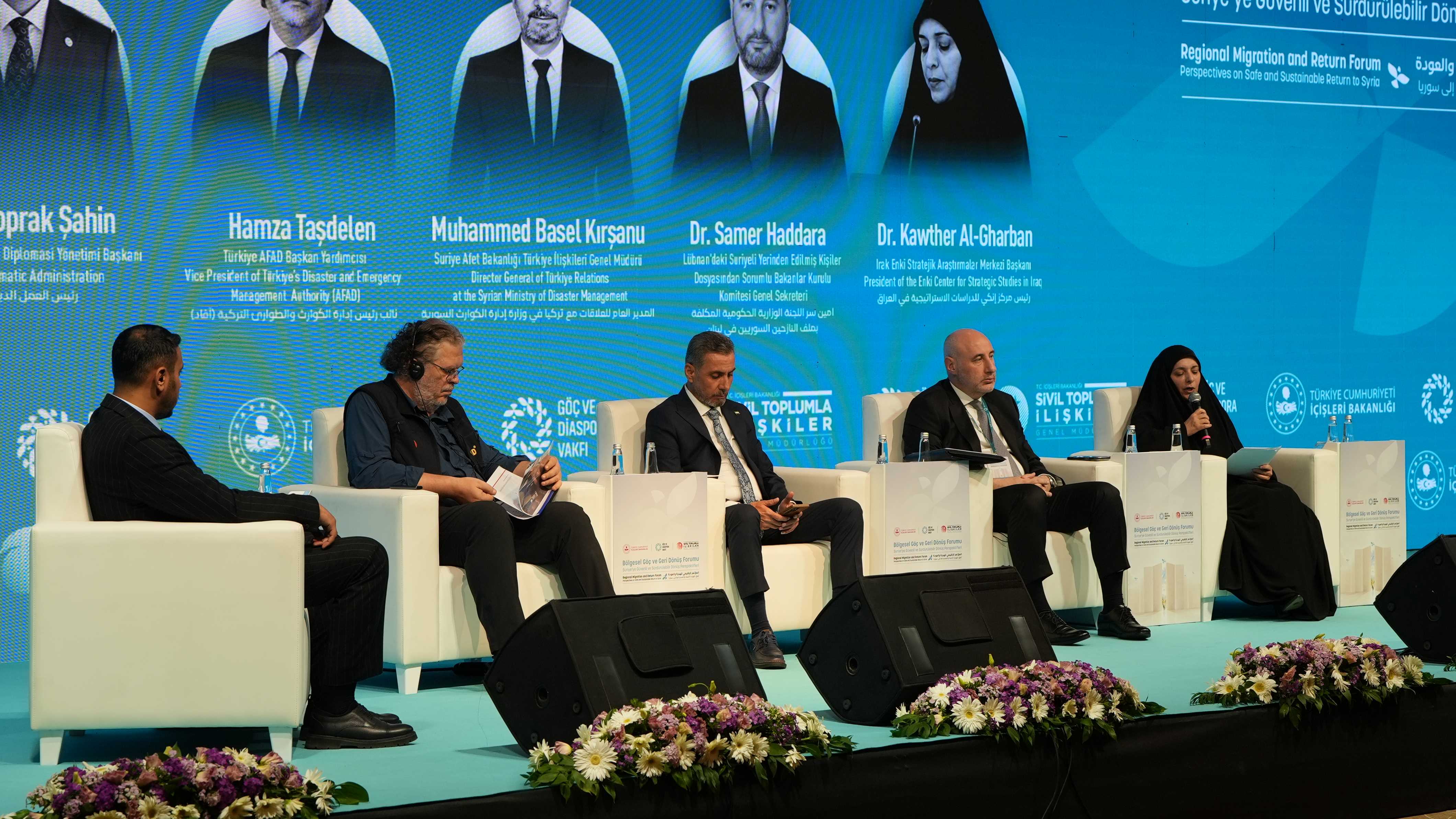
In the Special Session on Regional Migration Management Experience held within the scope of the Regional Migration and Return Forum, institutional experiences and field practices of regional countries regarding migration management were shared.
In the session moderated by Barış Toprak Şahin, Head of Diplomacy Management at the Migration and Diaspora Foundation; Hamza Taşdelen, Vice President of Turkish AFAD; Muhammed Basel Kırşanu, Director General of Turkey Relations at the Syrian Ministry of Disasters; Dr. Samer Haddara, Secretary General of the Council of Ministers Committee Responsible for the Syrian Displaced Persons File in Lebanon; and Dr. Kawther Al-Gharban, President of the Iraqi Enki Center for Strategic Studies shared their views.
AFAD Vice President Taşdelen: Wherever in the world someone is in need, we try to lend a helping hand

Summarizing the process Turkey has conducted since 2011 in three periods, AFAD Vice President Hamza Taşdelen stated that in the first period, efforts were made to cope with mass migration. In this context, he expressed that 26 temporary accommodation centers were established across 10 cities, hosting over 300 thousand Syrians.
Referring also to the briquette house project born out of field practice, Taşdelen said that the work initiated with a target of 20 thousand resulted in the completion of 116 thousand briquette houses, which prevented the constant displacement of the population in the region and enabled the planning of school, health, and infrastructure services. He also noted that aid is regularly delivered to the field via the logistics center established in Çobanbey.
Taşdelen drew attention to the fact that return should be evaluated as a concept encompassing not only the return to Syria from neighboring countries, but also the return of internally displaced persons within Syria to their own cities. Reminding that 252 million people in 55 countries worldwide are in need of urgent assistance, Taşdelen expressed that AFAD acts with an approach that "tries to lend a helping hand wherever in the world someone is in need."
Dr. Al-Gharban: Social trust was decisive in Iraq's experience

Dr. Kawther Al-Gharban, President of the Iraqi Enki Center for Strategic Studies, stated that Iraq's experience was predominantly shaped around internal migration, expressing that the country faced a heavy wave of forced displacement due to Al-Qaeda and ISIS terrorism.
Emphasizing that migration management is a security issue as much as an organizational issue, Al-Gharban said that the state must strike a balance between national security and the safety of human life. She stated that in the model pursued in Iraq, involving reputable actors in society alongside state institutions made the crisis manageable.
Regarding the status of Syrians in Iraq, Al-Gharban relayed that no nationality-based discrimination is practiced in the country; Syrians have the right to travel and work, and Syrian doctors and healthcare workers can serve in hospitals. Expressing that the experiences of Turkey and Iraq are distinct yet mutually enriching, Al-Gharban stated that evaluating both experiences together would contribute to regional policies.
Dr. Haddara: An accurate migration policy cannot be produced without accurate data

Dr. Samer Haddara, Secretary General of the Council of Ministers Committee Responsible for the Syrian Displaced Persons File in Lebanon, stated that the government formed at the beginning of 2025 placed the issue directly on its agenda by establishing a committee at the ministerial level. He relayed that the plan prepared with international partners aims to encourage voluntary return through financial support, administrative conveniences, and fee and tax exemptions.
Haddara expressed that there are currently approximately 800 thousand Syrians in Lebanon, while around 600 thousand people have returned to Syria; as of July 2026, approximately 100 thousand students are enrolled in schools. He stated that these data demonstrate that migration management is not possible without taking education policies into account.
Drawing attention to the importance of accessing quality data, Haddara said that statistics obtained at the national level can contradict data from international institutions, and therefore data sharing between institutions and states needs to be strengthened. Exemplifying that there are families wishing to return to the same city from different countries, Haddara called for the establishment of a joint regional platform so that the service and infrastructure needs generated by these returns can be planned in advance.
Emphasizing that returnees should be evaluated not merely as individuals in need, but along with the professional skills and economic potential they carry, Haddara stated that the success of the process will be the success of not only Syria but the entire region, concluding his speech with the words "The stability of Syria is the stability of the region."
Kırşanu: This is a second migration; a voluntary and dignified return

Muhammed Basel Kırşanu, Director General of Turkey Relations at the Syrian Ministry of Disasters, stated that the ongoing process has the character of a new migration, expressing that the first migration occurred under forced conditions, whereas what is being discussed today means returning to the homeland voluntarily.
Emphasizing that return must be within a safe, voluntary, and humanitarian framework, Kırşanu stated that the Syrian government primarily tries to support the education and health sectors. He relayed that debris removal, clearance of mines and unexploded ordnance, and the re-establishment of critical infrastructure are the main challenges ahead.
Expressing that they consider securing livelihoods critical for returning families to build a sustainable life, Kırşanu said that the decree issued in this direction aims to create the infrastructure and environment to facilitate return. Emphasizing that returnees are a gain for the country, Kırşanu stated that this human capital will be utilized in reconstruction and development processes.
It was also expressed in the session that Turkish institutions such as AFAD, the Presidency of Migration Management, TİKA, YTB, Yunus Emre Institute, and Maarif Foundation carry out coordinated efforts towards the reconstruction of Syria, and an increase in returns was observed around newly constructed schools, demonstrating the decisive role of education and infrastructure in return.
Presentation of appreciation to the contributing speakers

Following the panel, Muhammed Ali Özoğul, Board Member of the Migration and Diaspora Foundation, presented thank-you gifts to Hamza Taşdelen, Muhammed Basel Kırşanu, Dr. Samer Haddara, and Dr. Kawther Al-Gharban for their valuable contributions to the forum.