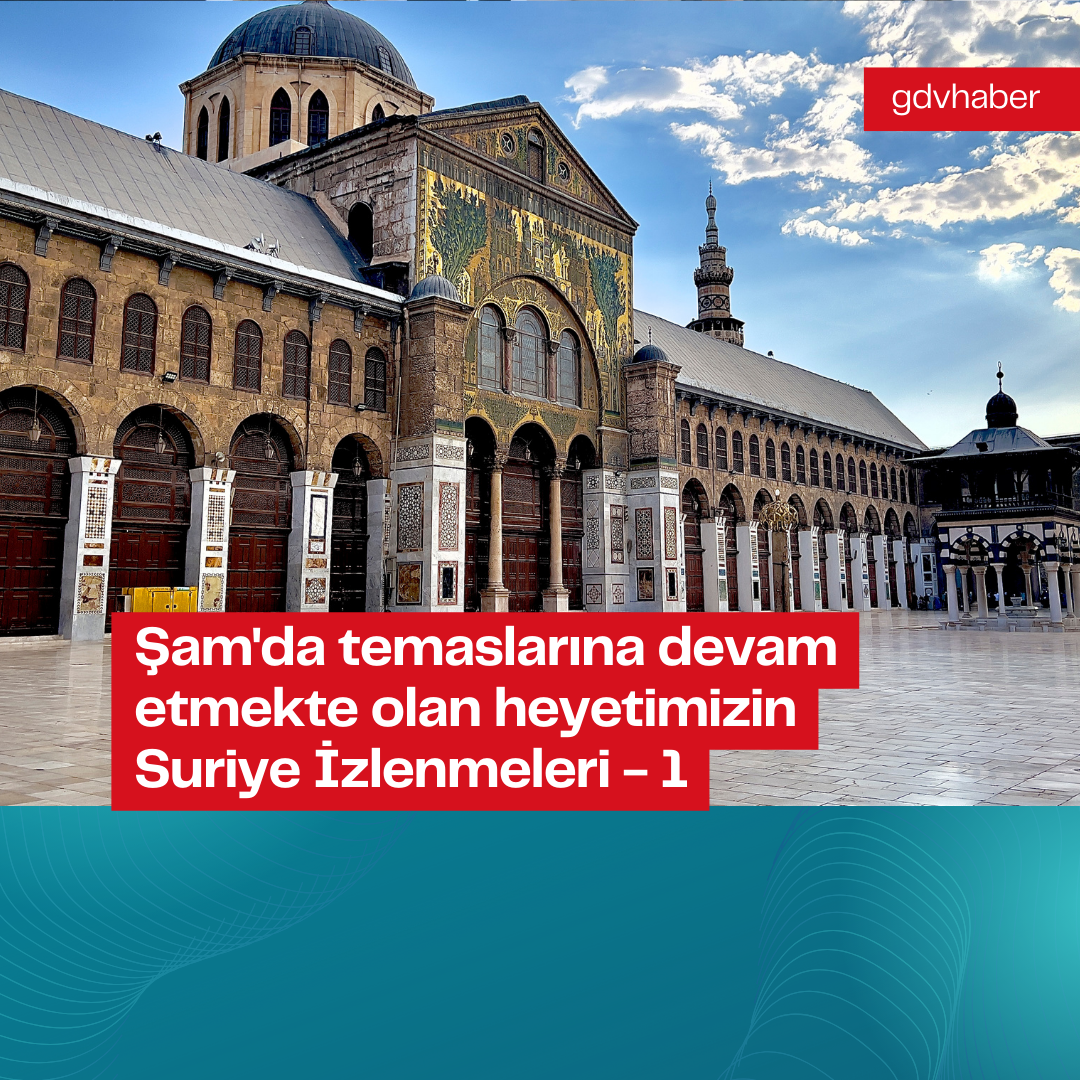
Syria Observations of Our Delegation Continuing Its Contacts in Damascus -1
- For the interim government structure in Damascus to be formed on a sound footing, it would be very beneficial to increase its mutual contact with the Turkish bureaucracy and, through this contact process, to support the establishment of the bureaucratic structure in Damascus. In this process, the participation of NGOs alongside state institutions will accelerate the process and provide a serious contribution to Syria's stability.
- The inclusion in the process, in various roles, of actors who came to the fore during the revolution process could provide a benefit that contributes to the current administration's social and political legitimacy and narrows the ground for malicious foreign-sourced operations. - The city of Damascus is, in a general sense, undamaged in terms of its infrastructure and superstructure, but other cities are in a state of serious damage in terms of both infrastructure and superstructure. Significant portions of cities that experienced conflict, such as Aleppo, Hama, and Homs, have images similar to the cities of Türkiye affected by the 6 February earthquake.
- Although no destruction is seen in Damascus, its infrastructure is seriously outdated, its roads are unmaintained, and its internet and communication infrastructure is very outdated and inadequate. It stands as it was built 20 years ago, with no renewal having been carried out.
- Throughout the country, economic difficulties have reached serious dimensions. The Syrian lira has lost serious value. Whereas in 2008 1 USD = 55 Syrian lira, before the opposition took over the Damascus administration it had reached the level of 1 USD = 40,000 Syrian lira; although it fell to the level of 1 USD = 11,000 Syrian lira with the opposition's takeover of the Damascus administration, these days it is around 1 USD = 14,000 Syrian lira. Exchange-rate volatility is very high, and stability has not yet been achieved in the markets. (Even in payments for food and drink, payments are made with bundles of 100 banknotes, and it is the bundles that are counted, not the number of bills. When you exchange 100 USD, you need to have a bag with you to carry the Syrian lira you will receive.)
- Outside the areas liberated and reconstructed with Türkiye's support, a serious fuel problem is seen. Fuel is sold in jerry cans on the roads. Although the fuel price is close to the price in Türkiye, it is very high for the Syrian market.
- The road between the Türkiye border and Damascus is very worn out and is far from meeting the logistical need required for the country's reconstruction. From the funds to be provided for the reconstruction of Syria's infrastructure, the planning and commencement of work on the Gaziantep–Damascus railway line could see Türkiye obtain a very important economic opportunity in meeting the logistical needs of cities such as Aleppo, Hama, and Homs — located along the railway line and almost all of which require reconstruction.
- Many Syrian actors whom we know from Türkiye prefer to enter from Lebanon with their passports rather than coming to Damascus to carry out the work here by obtaining 15-day or similar limited permits from the Ministry of the Interior. In the work they will carry out for the reconstruction of their own homeland, it is essential to swiftly develop methods through which they will make free entries and exits, not limited permits.
- In line with the latest statements coming from Iran, the instability projects they wish to create — by supporting the PYD-PKK terrorist organization or by inciting different structures within Syria — are also being evaluated by the actors here; it is assessed that, although these activities cannot reach a point that would prevent the establishment of stability, they have the potential to produce short-term crises and terrorizing actions.
- The Syrian citizens we encountered on the street, in the bazaar, and on the roads in Syria show serious affection and warmth when they learn that we have ties with Turks. They express their satisfaction that Türkiye has not left Syria alone in this transition process and has contributed by providing support at the highest level.
For our state to successfully complete the role and responsibility it has assumed in the reconstruction and revival of Syria, a collective initiative must be put forward hand in hand by the State, NGOs, and the Nation. The transformation of the shared-fate perception that has formed between the peoples of the two countries into a strategic togetherness is of importance not only for Türkiye and Syria but also for regional peace and stability.