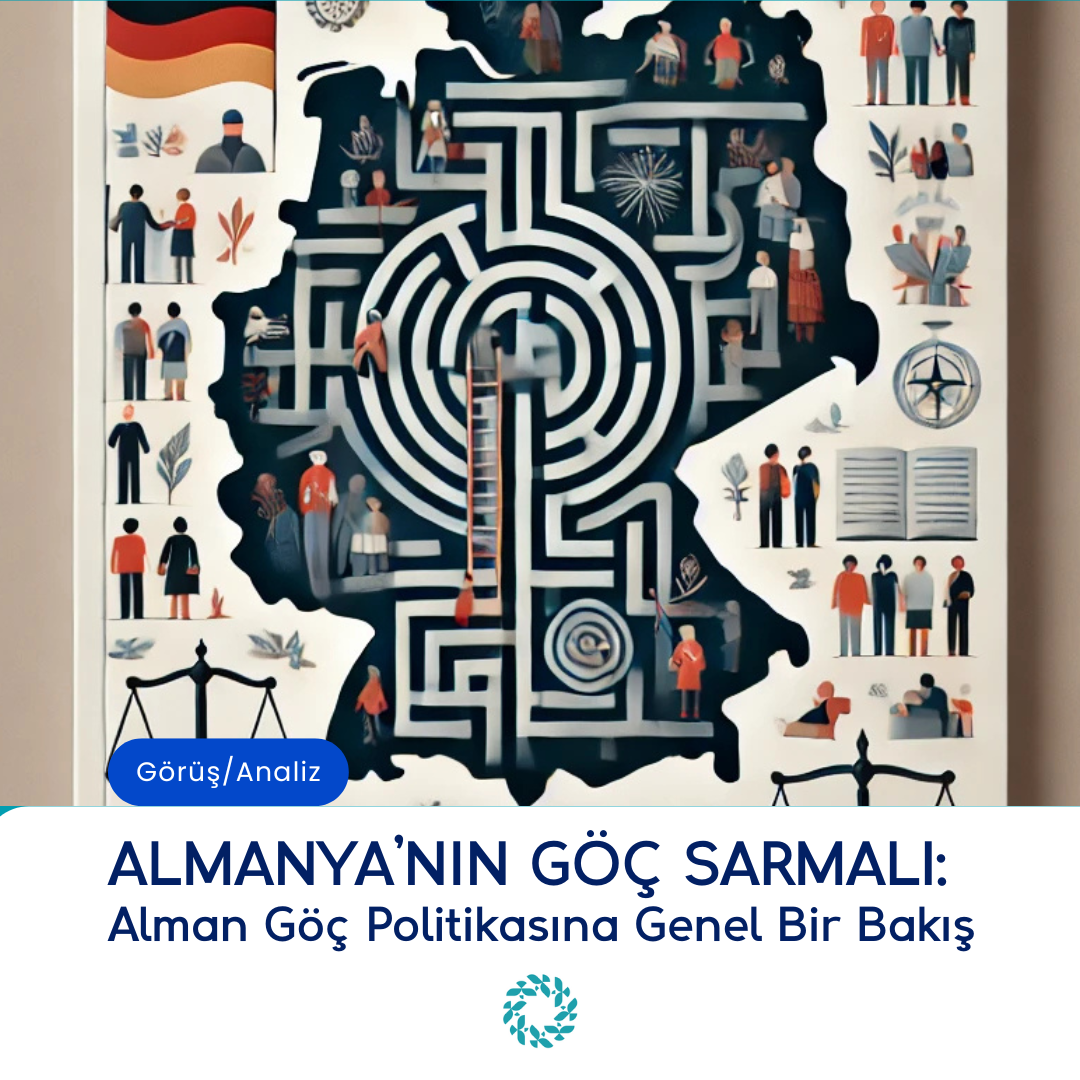
GERMANY'S MIGRATION SPIRAL:
A General Overview of German Migration Policy
Germany is a country of immigration.[1] Although reaching this conclusion took a significant amount of time for the state in question, Germany has without doubt been a country of immigration for a very long time. When the developments that have occurred especially since the Second World War are listed one after another, this matter will have no choice but to arrive at the truth.
In the historical flow, it is seen that Germany responded to various migration flows in different ways and developed a policy in a certain direction.[2] The course of the historical development of the migration policies of Germany — which has seen the peaks of migration mobility among EU countries — developed in parallel with the political concerns of the state in question. Whether it will be said that Germany, which initially had a migration approach along a national/racial line, moved away from this idea as it approached the present day, or rather developed and reinforced it, will at a certain point remain a mystery. In short, German politics, through the practical solutions it has developed for migrants and the phenomenon of migration, reveals the picture of an ideology.
It is possible to provide a top-down view of German migration politics by setting out from some practical examples. In a more detailed and in-depth study, it is more likely that the background of these policies can be seen.
MIGRATION IN HISTORY AND GERMAN POLICIES
It is useful to state at the outset that Germany has been tested at 3 important points throughout history with the phenomenon of migration: the pre-unification period, the period from the Second World War to the Oil Crisis, the period from the Oil Crisis to the unification of the German blocs, and the present day.[3] Throughout this entire historical process, the migration movement was sought to be kept under control, and the state was, as it were, sought to be protected from the harms of migration.
It is quite explanatory to express this protectionist view, in its common usage, in the form of "Secure Borders, Safe Haven." It is also inevitable to say that this point of view is a policy that the entire world has embraced in the face of migration — perhaps not openly, but conducted covertly.[4] Indeed, especially when German politics is examined closely, the belief that the paradise state passes through secure borders occupies quite a large place.
In the post-Second-World-War period, in which 12 million ethnic Germans were forced to migrate, those who were persecuted became acquainted with the right of asylum in 1949 through the Grundgesetz.[5] As a result of the developments here, those who were ethnically German were able to return to their own country. This both lays bare Germany's nationalist politics and reveals that population growth could not be achieved at the desired level in this period. It is precisely at this point that, together with the labor agreements, the story of the Turks — who comprise a serious portion among Germany's migrants — begins.[6] Again, in order to explain Germany's protective migration policy with examples, it is useful to give place to the following matter: Germany closed off the path of the dual-citizenship practice for migrants of Turkish origin, made citizenship transitions subject to difficult conditions, and gave place to practices that damage human dignity, such as the "Conscience Test."[7] What is understood from this is that a person of Turkish origin, in order to obtain German citizenship, must — in addition to fully and completely embracing German culture — so strip away their migrant status that they must sever their ties with the country of nationality from which they migrated here.
As is accepted in international law, it is a fact that the state has absolute authority on a matter such as citizenship. But in order to shed a little more light on this matter, Germany's practices toward migrants in, for example, the labor market may be touched upon. Germany, as a whole, implements a graduated practice toward migrants. In working life as well, this situation confronts us in the same way. For Germans and "privileged foreigners with a special work permit provided by the state," hardly any problem can be spoken of in terms of the work permit and the conditions of working life. But on the other side, the possession of even a work permit, especially by citizens of third-world countries, has been made subject to quite detailed conditions. In the end, the work permit provided is also limited and time-bound. So much so that it can even be determined that a person from a third-world nation's entry into any job depends on the absence there of the Germans and privileged foreigners just mentioned.[8]
Such compelling conditions go as far as migrants falling behind in economic, psychological, and educational terms and striving to attain success by different means. In a system in which integration efforts have fallen behind and their place has been taken by compelling, restrictive migration policies, it will be inevitable for migrants to fall into a disadvantaged status. Even today, so-called protective foreigner policies have played a role in bringing Turks, or Pakistanis in a similar position, to this point in Germany.
On the other hand, it is useful to note that Germany is also a country that possesses serious developments in integration efforts. When we leave aside for a moment the negative matters we mentioned above — and if we also do not count the period in which, by being called "guest workers," even their permanence was not accepted and for this reason no work was done — Germany expanded its integration efforts the moment it noticed the migrants' effort to build a life. For example, with the National Integration Plan that was created, a serious concentration occurred on work, education and instruction, employment, and cultural integration.[9] The German Government, which organized courses within this scope, spread these courses throughout the country and made them compulsory.
Certain particular matters are included in the integration courses in question. The most important of these are, of course, the teaching of German values and culture and the raising of migrants' knowledge of the German language to a certain level.[10] Especially migrants who are certain to stay in Germany for more than a certain period are expected to know German at a good level.
Although all these efforts appear to some of the migrants as an "assimilation effort," it stands to be made sense of that such a nationalist government in particular would enter into such an endeavor. Thus, the middle point of the Germans living in Germany and the privileged foreigners living together with the so-called migrants coming from third-world nations was sought.
Germany stands before us as a state that has built a serious and complex law/policy of foreigners in this cause, continuing to be constantly tested by the matter of migration. But the seriousness and difficulty of the matter of migration is also a matter that truly is not to be taken lightly. According to Michael Walzer, the domination of citizens over non-citizens and foreigners is probably the most barbaric form of despotism in the history of humanity.[11]
Germany, too, has developed a reflex similar to that of many European countries against these matters and has responded in two ways: 1) Building strict control and selection mechanisms for migrants at entries into the countries through policing and security measures; (2) Differentiating and stratifying rights toward migrants through laws.[12]
The first sentence of the first article of the Grundgesetz (Basic Law) begins with "Die Würde des Menschen ist unantastbar.": Human dignity is inviolable. It is ordinary and to be expected that a law that sets out to build legislation with such a beginning would, while making a distinction (?) of foreigner – migrant – citizen, recall at every opportunity the human dignity it holds at the highest rank.
Att. Emrehan Parlak
Migration and Diaspora Foundation
To browse the author's other articles, click here.
Bibliography
Altan, Hale Nur, ve Muhammet Musa Budak. "İkinci Dünya Savaşı Sonrasında Almanya Göç Politikalarının Dönüşümü." Gaziantep University Journal of Social Sciences 22, no. 4 (2023): 1409–1423.
Güllüpınar, Fuat. "Almanya’da Göçmen Politikaları ve Türkiyeli Göçmenlerin Trajedisi: Yurttaşlık, Haklar ve Eşitsizlikler Üzerine." Anadolu Üniversitesi Sosyal Bilimler Dergisi 14, no. 1 (2014): 1–16.
Morris, Lydia. "New Labour's Community of Rights: Welfare, Immigration and Asylum." Journal of Social Policy 36, no. 1 (2007): 39–57.
Sachverständigenrat für Integration und Migration (SVR) gGmbH. Migration und Integration: Entwicklungen von 2019–2024. Zahlen und Fakten zum SVR-Jahresgutachten 2024. Berlin: Neue Promenade 6, 10178, 2024.
[1] Sachverständigenrat für Integration und Migration (SVR) gGmbH. Migration und Integration: Entwicklungen von 2019–2024. Zahlen und Fakten zum SVR-Jahresgutachten 2024. Berlin: Neue Promenade 6, 10178, 2024. S.1
[2] Altan, Hale Nur, ve Muhammet Musa Budak. "İkinci Dünya Savaşı Sonrasında Almanya Göç Politikalarının Dönüşümü." Gaziantep University Journal of Social Sciences 22, no. 4 (2023): 1411
[3] Altan, Hale Nur, ve Muhammet Musa Budak. "İkinci Dünya Savaşı Sonrasında Almanya Göç Politikalarının Dönüşümü." Gaziantep University Journal of Social Sciences 22, no. 4 (2023): 1411
[4] Güllüpınar, Fuat. "Almanya’da Göçmen Politikaları ve Türkiyeli Göçmenlerin Trajedisi: Yurttaşlık, Haklar ve Eşitsizlikler Üzerine." Anadolu Üniversitesi Sosyal Bilimler Dergisi 14, no. 1 (2014): 1
[5] Altan, Hale Nur, ve Muhammet Musa Budak. "İkinci Dünya Savaşı Sonrasında Almanya Göç Politikalarının Dönüşümü." Gaziantep University Journal of Social Sciences 22, no. 4 (2023): 1412
[6] Sachverständigenrat für Integration und Migration (SVR) gGmbH. Migration und Integration: Entwicklungen von 2019–2024. Zahlen und Fakten zum SVR-Jahresgutachten 2024. Berlin: Neue Promenade 6, 10178, 2024.
[7] Güllüpınar, Fuat. "Almanya’da Göçmen Politikaları ve Türkiyeli Göçmenlerin Trajedisi: Yurttaşlık, Haklar ve Eşitsizlikler Üzerine." Anadolu Üniversitesi Sosyal Bilimler Dergisi 14, no. 1 (2014): 7
[8] Güllüpınar, Fuat. "Almanya’da Göçmen Politikaları ve Türkiyeli Göçmenlerin Trajedisi: Yurttaşlık, Haklar ve Eşitsizlikler Üzerine." Anadolu Üniversitesi Sosyal Bilimler Dergisi 14, no. 1 (2014): 9
[9] Altan, Hale Nur, ve Muhammet Musa Budak. "İkinci Dünya Savaşı Sonrasında Almanya Göç Politikalarının Dönüşümü." Gaziantep University Journal of Social Sciences 22, no. 4 (2023): 1415
[10] Altan, Hale Nur, ve Muhammet Musa Budak. "İkinci Dünya Savaşı Sonrasında Almanya Göç Politikalarının Dönüşümü." Gaziantep University Journal of Social Sciences 22, no. 4 (2023): 1416
[11] Morris, Lydia. "New Labour's Community of Rights: Welfare, Immigration and Asylum." Journal of Social Policy 36, no. 1 (2007): 39–57.
[12] Güllüpınar, Fuat. "Almanya’da Göçmen Politikaları ve Türkiyeli Göçmenlerin Trajedisi: Yurttaşlık, Haklar ve Eşitsizlikler Üzerine." Anadolu Üniversitesi Sosyal Bilimler Dergisi 14, no. 1 (2014): 3