The Social Life of Syrian Refugees
The presence of Syrian refugees in Türkiye, together with the economic bottleneck in the country and the operations in Northern Syria, has become a serious subject of debate in both the social and political arenas. In such a climate, where Syrians are mostly associated with problems, writing an article that places the social lives of Syrian refugees at its center — addressing what they do in their free time and the problems they encounter in these activities — may at first seem strange; after all, such a study focuses on how Syrians enjoy life and how they "have fun." In this context, one of the questions we must ask ourselves is this: "Do refugees have the right to have fun?" What inspired the study I conducted as part of my doctoral thesis was the rhetoric I increasingly encountered both on social media and in real life regarding Syrian refugees: "while our soldiers are being martyred in Syria, Syrians are enjoying themselves here, smoking hookah on our shores" (DHA, 2016; Erdogan-Ozturk & Isik-Guler, 2020; T24, 2018). Although most of the research I examined contained data indicating that Syrians are subjected to exploitation in working life and to exclusion in social life, the emerging stereotype of the "Syrian smoking hookah on the shore" caught my attention, and I decided to conduct a study on what Syrian refugees do in their free time.
It must be that "refugees having fun" is not a phenomenon people are very accustomed to, not only in Türkiye but in the world as well, for we see that studies addressing the leisure activities of migrants are not sufficient (Horolets, 2012; Stodolska, 1998). For example, according to one study, of 3,669 articles published in various journals related to leisure activities, only 12 addressed migration and leisure activities (Hasmi et al., 2014). The existing studies, meanwhile, show that meaningful, purposeful, and enjoyable leisure activities play an important role in the adaptation and integration of refugees into the society to which they have come (Stack & Iwasaki, 2009). Another study showing the importance of the role leisure activities play in integration is the Home Office 2019 Indicators of Integration Framework, developed by the United Kingdom Home Office to monitor the integration process and to put forward effective strategies on the subject. In this Framework, leisure activities are categorized as a fundamental element, unlike the earlier study on which this framework is based (Ndofor-Tah et al., 2019). Attention has been drawn to the positive role leisure activities play in the migrant's learning of the culture of the host country, developing social relations with the native society, learning the language, and increasing their general well-being. Accordingly, leisure activities stand out both as a tool for improving integration and as evidence showing that integration has taken place. In this respect, for the genuine social and cultural integration of Syrian refugees — who have lived in our country for more than a decade and have, for better or worse, integrated into economic life — it is necessary to look at what they do in their free time and at the problems they encounter here. For there are also studies showing that leisure activities lead to discrimination, to ethnic and intercultural tensions, and to conflicts (Stodolska, 2015).
In order to fill the gap I mentioned above and to create awareness in this sense, I conducted a study with 48 Syrians from different social classes, the majority of whom live in Istanbul. The study's data consists both of in-depth interviews conducted with the participants and of observations obtained from visits to the participants' homes, their workplaces, and the cafés and restaurants where they socialize. In the interviews conducted, I first asked what the participants understood by leisure activities,[1] and then what kinds of leisure activities they engaged in both in Syria and in Türkiye. Accordingly, we determined that leisure activities occupy an important place in the lives of Syrian refugees, and that in this sense the participants see themselves as different from Turks.
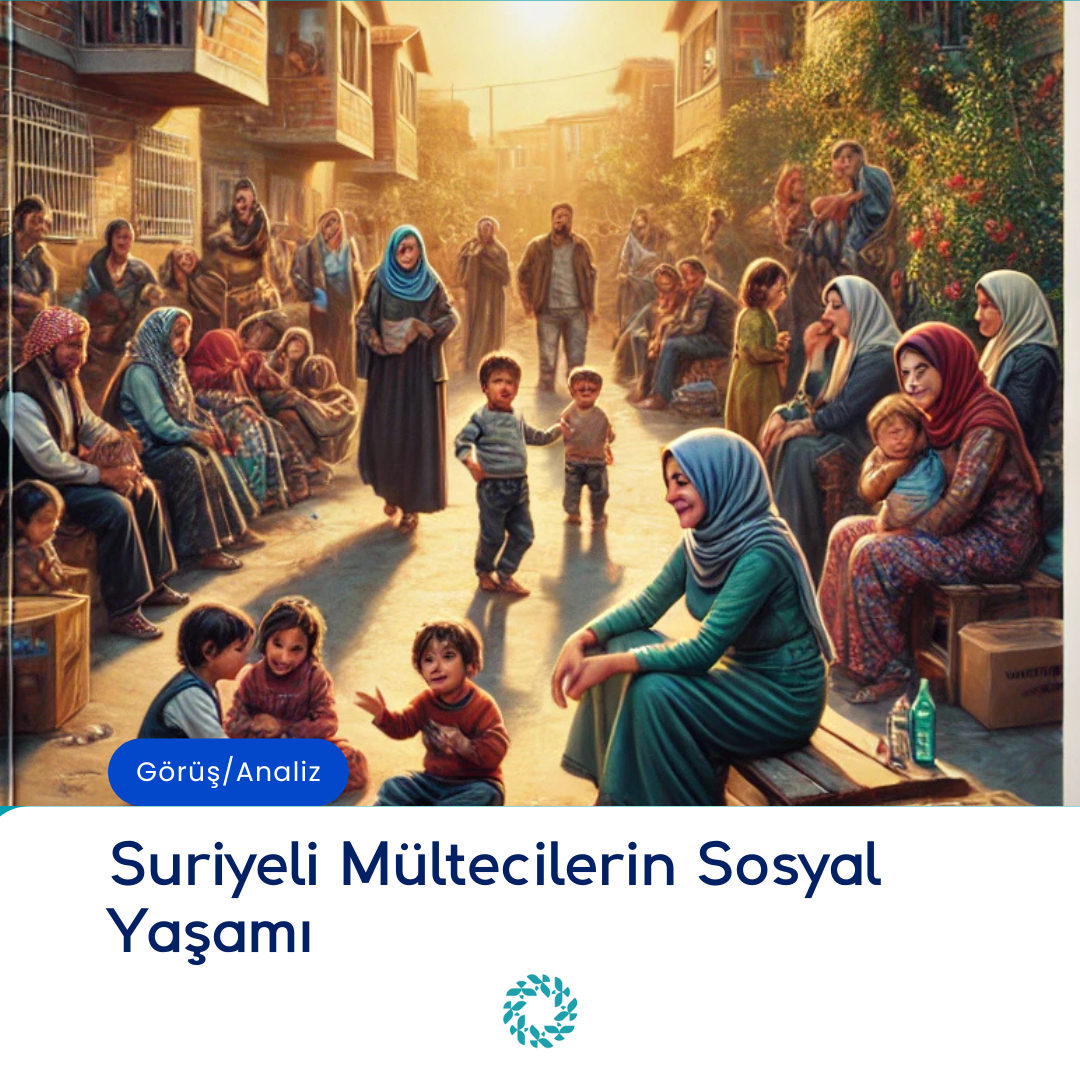
The participants frequently stated that Turkish society leads a work-based life and does not give enough importance to leisure activities. We determined that the leisure activities the participants engaged in in Syria were mostly family-based, and that in this sense activities such as relative visits, picnics, and camping — through which they could spend time together with family and relatives — stood out. In Türkiye, we observed that similar activities continued, but that, especially for participants coming from rural areas, both participation in activities and the diversity in the types of activities engaged in increased. For example, we saw that relative visits became even more important in Türkiye, and that minority psychology and the exclusion they faced were influential in the emergence of this situation. Another striking point is that the Fatih district emerged as an important leisure space for the participants. The presence of Syrian cafés, restaurants, and markets there, the Fatih Mosque, and the conservative demographic of the district created an environment in which Syrians do not feel themselves to be a minority and can socialize comfortably without fear of exclusion. For example, some participants stated that they come here because it reminds them of Syria, and sometimes just to hear people speaking Arabic around them. Therefore, the most frequent answer given to the question "what do you do in your free time" was "we go to Fatih." Fatih is, in a way, a place where they can eat Syrian food, worship together with their fellow believers in the Fatih Mosque, and, when they go out, see people like themselves — in other words, a place where they feel "at home" and "normal." Another important leisure activity for the participants is the events of NGOs; the participants take on various roles in these events both as participants and as volunteers. This becomes an important social channel through which they can come together with both other Syrians and Turks. Finally, we observed that the participants are generally compelled to prefer low-cost leisure activities. For example, activities such as walking in the park, going to the seaside, spending time at home, going to visit relatives, and spending time on social media are preferred.
Syrian refugees encounter various constraints in their leisure activities. Naturally, unlike the native society, we observed the existence of constraints stemming from Syrians being refugees. When we categorize these constraints according to the leisure-constraints model developed by Crawford and colleagues (1991) (Crawford et al., 1991), we determined that Syrian refugees are most affected by structural constraints, followed by intrapersonal and interpersonal constraints.
To examine them in order, we determined that among the structural constraints, those stemming from legal status, gender norms, and knowledge of the language stood out. For example, because of their legal status, Syrian refugees are subject to a permit process to go outside the provinces in which they are registered; this situation restricts their freedom to travel for reasons such as touring or vacation. For instance, one participant recounted an incident in which they were stopped by a police officer and asked the reason for their travel; when they answered that it was to have fun, they said the police officer responded as follows:
"No, go home. You don't need to have fun. You are Syrian…" (Zuhair, male, middle class).
Similarly, because of their legal status, it is also difficult for them to access the legal labor market, which affects their income and directly affects the time and money they can set aside for leisure activities. Another structural constraint is gender norms. We observed that most Syrian women cannot participate in leisure activities, or can participate less than men, because of gender norms and roles. For example, we witnessed that participants could not go out of the house on their own, that in some cases they suffered violence from their families, and that in some cases they saw marriage as a means of liberation in order to attain their freedom. We observed that some Syrian women, because of neighborhood pressure, spend their free time in districts such as Kadıköy, Beşiktaş, and Taksim, where there are no Syrians. Finally, we saw that, despite the time that has passed, Turkish continues to remain a serious structural constraint. We determined that the lack of language seriously restricts both Syrians' job opportunities and their interaction with Turkish society.
When we look at intrapersonal constraints, we see that discrimination stands out as the most important constraint, followed by religiosity and the psychological effects of the war. We determined that most participants cut back on their leisure activities out of fear of being subjected to discrimination, and that, out of fear of experiencing trouble, they avoid situations in which they might interact with people. The participants stated that they are greatly affected by the "looks" they are subjected to, especially in public spaces.
For example, one father stated that he avoids taking his children to the park because he has to use public transportation and people "look" at him there. In another example, a mother who took her child to the park stated that her child was excluded at the park because they were Syrian, and that they therefore stopped going. Some participants, meanwhile, stated that they do not take part in some activities for religious reasons. For example, there were participants who stated that they do not go to the cinema both because it is mixed men and women and because of obscene scenes. Similarly, we observed that secular participants do not prefer the spaces where conservatives and Syrians have fun.
Finally, the psychological effects of the war also lead some participants to withdraw from social life, or to not enjoy these activities even if they do participate in them. Traumas such as the breakup of families and the death of some family and relative members in the war, and the fact that their future remains uncertain despite the decade that has passed, cause them not to enjoy most activities. When we look at interpersonal constraints, we see that the lack of neighbors, family, relatives, and a partner stands out.
Our participants stated that the neighbor, family, and relative visits that were very important to them in their lives in Syria weakened in their lives in Türkiye, that neighborly relations are weak in Türkiye, and that their neighbors do not want to associate with them. Most participants stated that their relations with Turks have decreased to the point of nonexistence, that they want to be friends with them, but that after the negative reactions they encountered they have given up hope of this. This situation leads Syrians to turn, for socializing, to fellow Syrians like themselves rather than to the native people, and therefore to concentrate in the same apartment buildings and neighborhoods. This situation will, in the long run, give rise to ghettoization and the formation of two parallel societies.
In the study, we determined that these constraints are not experienced to the same degree by every participant, and that there are factors such as social class, legal status, and gender that affect this. In the comparative analyses I made, we saw that the participants' social class in Syria seriously determined their life opportunities in Türkiye. We observed that persons in the high-income group or with a high education level did not encounter most of the problems faced by persons from the lower-income group, or were not affected to the same degree. Therefore, just as there are Syrians who can obtain citizenship, live in secure residential complexes, go to their destinations in their own private cars, regularly travel abroad, and know a foreign language, there are also Syrians who live in basement floors, are subjected to racism every day, and are exploited in working life. In this context, without disregarding either the positive role of leisure activities in integration or the dimension in which social tensions may be ignited, Türkiye needs to develop a serious leisure-management policy for migrants and refugees.
Dr. Emrah YAĞMURLU
Migration and Diaspora Foundation
To browse the author's other articles, click here.
Bibliography
Crawford, D. W., Jackson, E. L., & Godbey, G. (1991). A hierarchical model of leisure constraints. Leisure Sciences, 13(4), 309–320.
DHA. (2016, August 19). Suriyelilerin “nargileli” deniz keyfi. https://www.hurriyet.com.tr/yerel-haberler/mersin/suriyelilerin-nargileli-deniz-keyfi-40201160
Erdogan-Ozturk, Y., & Isik-Guler, H. (2020). Discourses of exclusion on Twitter in the Turkish Context:# ülkemdesuriyeliistemiyorum (# idontwantsyriansinmycountry). Discourse, Context & Media, 36, 100400.
Hasmi, H. M., Gross, M. J., & Scott-Young, C. M. (2014). Leisure and settlement distress: The case of South Australian migrants. Annals of Leisure Research, 17(4), 377–397. https://doi.org/10.1080/11745398.2014.948023
Horolets, A. (2012). Migrants’ leisure and integration. Polskie Forum Migracyjne II” Institute of Public Affairs Report, 27.
Ndofor-Tah, C., Strang, A., Phillimore, J., Morrice, L., Michael, L., Wood, P., & Simmons, J. (2019). Indicators of integration framework 2019. OGL: Home Office Migration and Border Analysis Unit.
Stack, J. A., & Iwasaki, Y. (2009). The role of leisure pursuits in adaptation processes among Afghan refugees who have immigrated to Winnipeg, Canada. Leisure Studies, 28(3), 239–259.
Stodolska, M. (1998). Assimilation and leisure constraints: Dynamics of constraints on leisure in immigrant populations. Journal of Leisure Research, 30(4), 521–551.
Stodolska, M. (2015). Leisure, ethnicity, race and migrations. In World Leisure Journal (Vol. 57, Issue 3, pp. 168–172). Taylor & Francis.
T24. (2018). Sahilde nargile içen Suriyelilere tepki gösterdi: Neden ülkenizde savaşmıyorsunuz? T24. https://t24.com.tr/video/sahilde-nargile-icen-suriyelilere-tepki-gosterdi-neden-ulkenizde-savasmiyorsunuz,14843
[1] Although the concept is translated into Turkish as "boş zaman aktiviteleri" (free-time activities), this is an activity-based definition and does not fully express the concept of "leisure." Leisure does not express only free time and activities; it also encompasses an emotion.