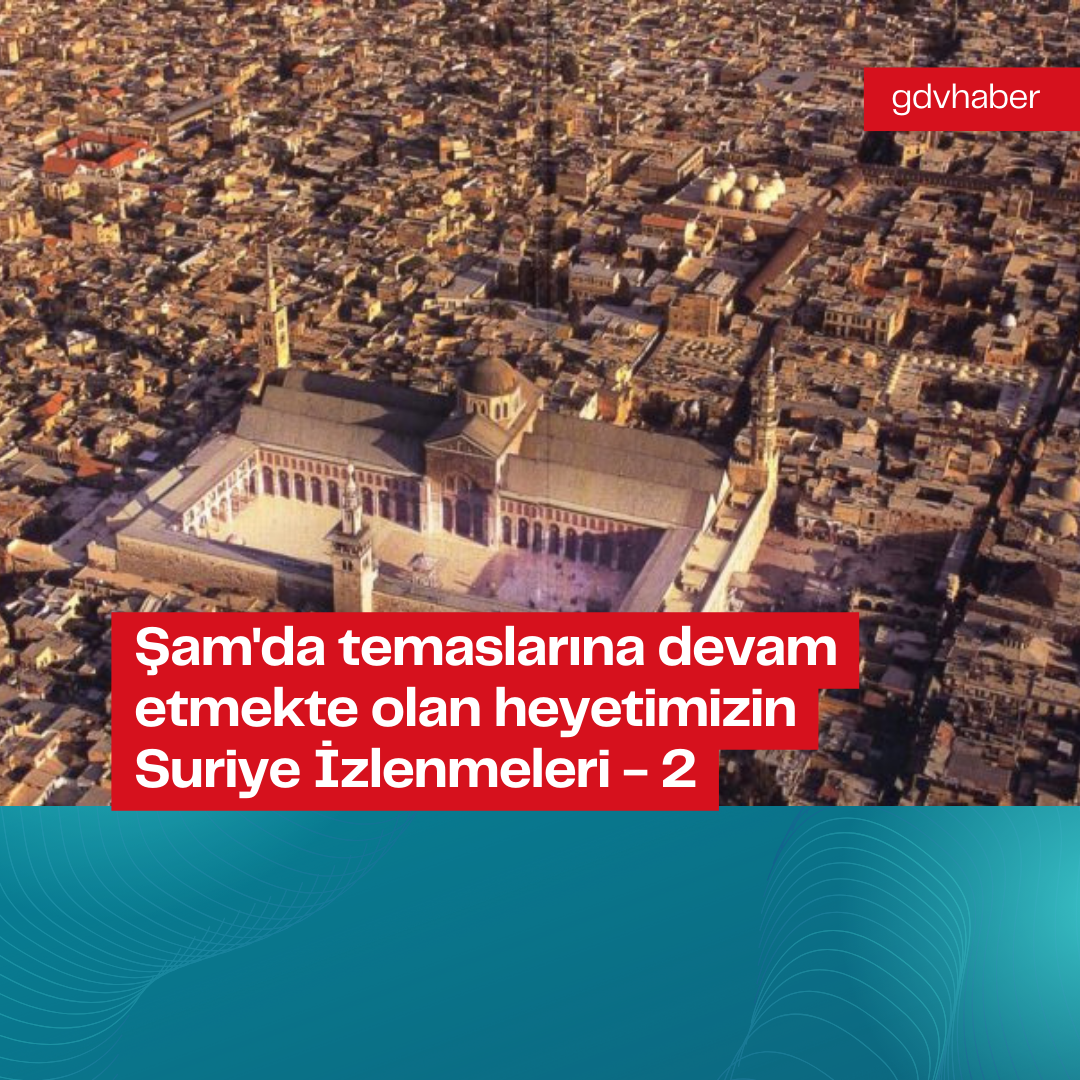
Syria Observations of Our Delegation Continuing Its Contacts in Damascus -2
- The fact that the meeting of revolutionary military group leaders, held the other day under the chairmanship of Ahmed al-Sharaa, ended in unity caused serious relief. All of the actors we spoke with made comments to the effect that "we spent our most comfortable evening since the toppling of Assad." We can say that one more very important step has been completed in the building of stability in Syria.
- In Damascus, schools, government offices, and official institutions continue to provide services, and life proceeds in its normal course. In a general sense, the perception that the city is safe prevails. There are döner shops, kiosks, and cafés open at night. The only problem at this point is that, because of the inadequacy of electricity, most of the city turns into a pitch-dark environment at night. On the matter of security, although civilian-looking armed shabiha located in certain areas try to disrupt stability with terrorist actions in the city, the measures taken keep these attacks at a very limited point. So far, the attacks target not the people but state institutions. Former regime elements who surrender their weapons and submit to the new administration are being pardoned. The shabiha groups in 2–3 areas refuse to surrender their weapons. They have also responded with fire to the teams that came to this area to collect the weapons. The footage circulated as if a massacre is being carried out consists merely of operations against former regime elements who continue to carry out such terrorist attacks and resist surrendering their weapons.
- Because of the loss of value in the currency, carrying cash and making cash payments is seen as one of Syria's most important problems. The banknotes in the market consist of 1,000-, 2,000-, and 5,000-lira notes. Because there is no credit-card system, the entire market runs on cash, and everywhere you go you encounter people counting bundles upon bundles of money. In all middle-class and above tradespeople's shops, a money-counting machine runs continuously at the till. Every day from the morning onward, a serious crush occurs in front of all the ATMs and long queues form. Establishing a serious monetary policy and a credit-card system swiftly is seen as essential. On this matter, opening the Troy card infrastructure for use by Syrian banks and its use in Syria could be evaluated as a fast and effective solution.
- The presence of Lebanese goods in the Damascus market is striking, from the gasoline sold in jerry cans by the roadside to beverages. In this, the advantage of the proximity of the Lebanese border in logistical terms continues. The expectation that Turkish merchants too will swiftly increase their activities within Syria and that Turkish goods will enter the Syrian market is also voiced by the tradespeople.
- The manner in which Israel's occupation activities in the south are advancing has reached a serious threat point. At the points it has reached, Israeli officials who invite actors such as the village headmen and judges in the villages regarding their villages hold meetings one by one; to actors who do not want to go to a meeting with Israel, the message is conveyed that if they do not come, the Israelis will come to them. Israeli officials who receive the answer that they should meet with the new Syrian administration say "that they do not recognize the current government and that at present they want to make agreements with local representatives, and that when a government they will recognize comes, they will make an agreement with that government over the situation that has arisen." It could be an important step for a regional alliance to develop a stance against this occupation attempt on Syria's southern border and to put forward the will to ensure the preservation of Syria's territorial integrity.
- Although the infrastructure and superstructure in the center of Damascus are outdated, it is seen that they have not suffered destruction. But when you move 3–4 km away from the center, the destruction in the city's outer periphery has made these areas uninhabitable. The destruction in the Jobar, Douma, Ghouta, and Yarmouk camp areas is at an indescribable point. For example, while 1.5 million people lived in the Yarmouk camp area before the war, at present 5,000 families continue their lives and strive to take hold of life in half-destroyed buildings amid the wreckage.
- The Syrian people generally appear satisfied with the current situation and have, as it were, bought hope. With each passing day, life continues to normalize. Whereas until 2 days ago soldiers with Kalashnikovs managed the traffic at intersections, now unarmed civilian police have begun to serve at the intersections. In the center of Damascus, the sidewalks on the streets are being painted by officials, some local associations are carrying out painting and decoration activities on the walls along the streets, aid organizations are carrying out humanitarian aid activities, and the advance delegations of Syrian civil society officials operating abroad are carrying out reconnaissance and office-opening work.
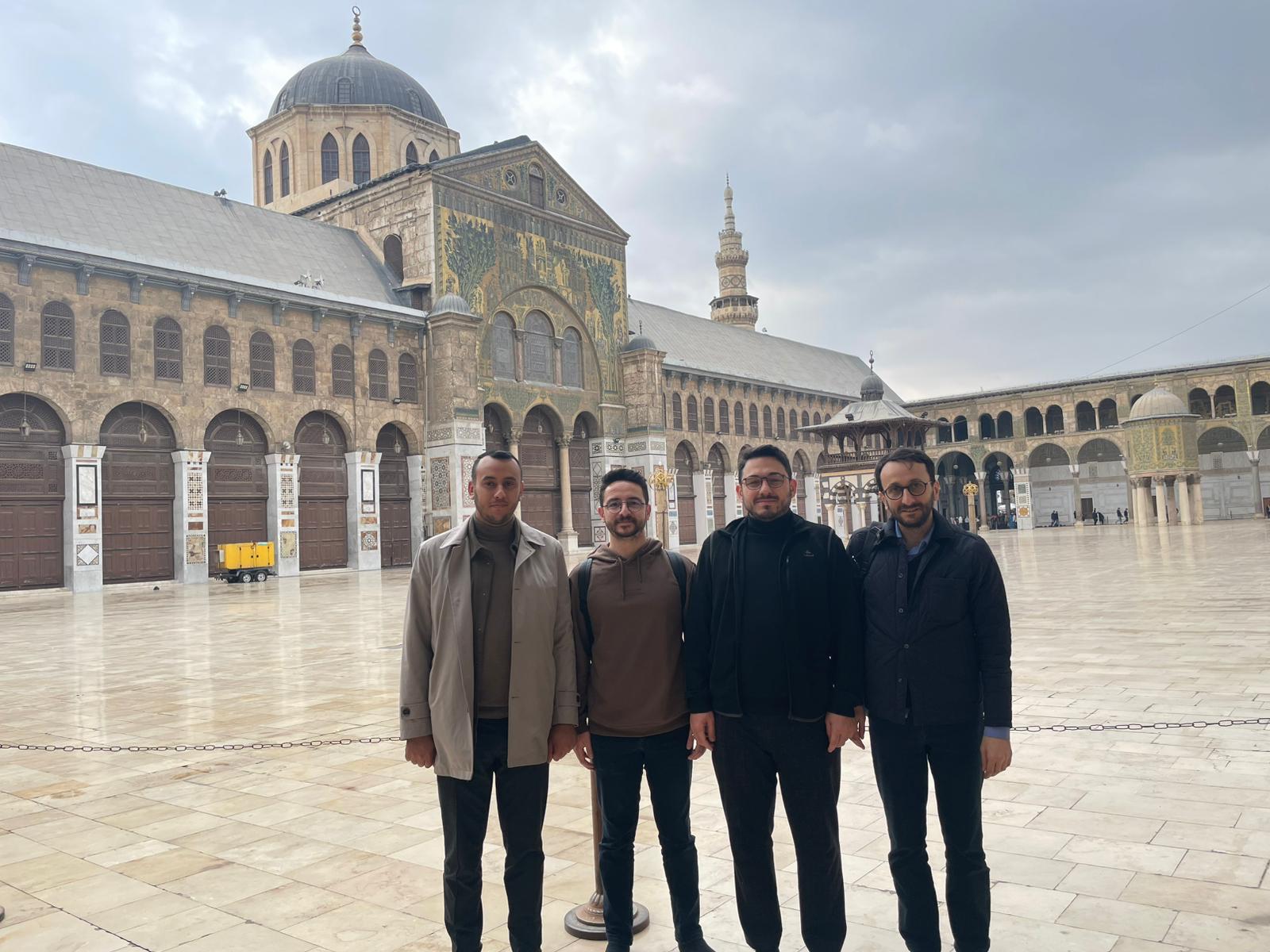
- In the eyes of the Syrian people, the coexistence of hope and fear is seen. When you begin to speak with people, it is seen that they are hopeful about the revolution but at the same time are seriously afraid that stability will be disrupted before it is established. It is precisely here that expectations from Türkiye regarding the building and preservation of stability are voiced. It is being talked about in the streets that our President Erdoğan will come to pray at the Umayyad Mosque, and people are asking when he will come.
- It is seen that there is serious anger and resentment toward Iran and Hezbollah, which have for years been the most effective force in Syria. When one looks at the surroundings of the shrine of Sayyida Zaynab, the granddaughter of our Prophet — which the Iranians used for years to legitimize their presence in Syria — it is not at all difficult to understand the reasons for this. The Iranians, who claimed to be in Syria to protect the shrine of Sayyida Zaynab, did not even repair the roads right next to the shrine's wall, made no investment, and left behind a great social and structural wreckage. To reach the shrine, you must, by vehicle, traverse roads ruined by ruins and collapses amid the wreckage, and as you go to the shrine's gate you must hop along muddy roads. The surroundings of the shrine are full of garbage and filth. It is seen that the need to carry out cleaning and reconstruction activity was not felt even around the place they consider most sacred. As the Republic of Türkiye, we must examine this bad experience carefully and preserve [the trust placed in us] with the attention and sensitivity that will meet the great hope nurtured toward us. There is now before us a brand-new Syria, with its government, its people, and its sociology. Before us stands a sociology formed by around 7 million people: of a population of around 5 million who, for 13 years, lived in areas under the regime's control, a portion in areas controlled by the PKK-PYD terrorist organization, around 2 million in northern Syria under the Interim Government administration, and around 4 million in the Idlib region under the administration of the Salvation Government — and who, over these 13 years, passed through different experiences in many different countries, including nearly 4 million in Türkiye as well as Lebanon, Jordan, Germany, and so on. For the traumatic situation created by this complex sociology and physical wreckage to be overcome, it is seen as essential that an exceedingly sensitive process be carried out with a holistic policy and intensive field contact.