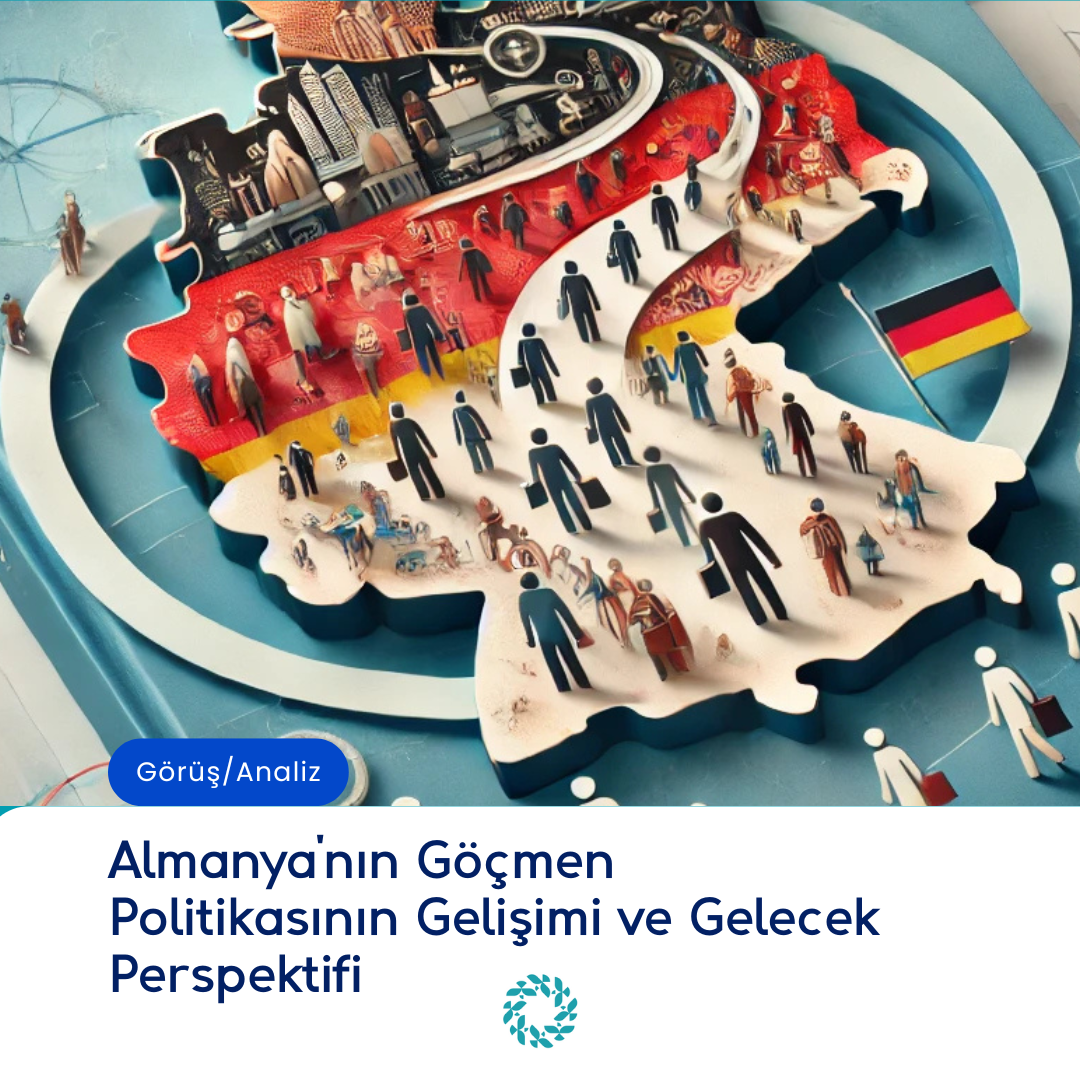
The Development of Germany's Migrant Policy and Its Future Perspective
In the process of transition to postmodern international relations, following the end of the bipolar world, the integration of the investments made in the field of military technology during the Cold War period into the transportation, information technology, and communication sectors led to the blurring of borders between nation-states and to an increase in intercontinental population mobility.
With the fall of the Berlin Wall, the negative aspects of East Germany's failed statist development policy also affected the perspective on migrants. Germany, which rebuilt the state system from the bottom up within a single piece of territory, began to define migrants — the most important element of demography — not in the status of guest workers but as one of the essential elements of the social structure. Within this framework, the transformation, during the formation process of citizenship policies, of the definition of the "ethnic nation" (Volksnation) through a birth-based citizenship policy for all those born within Germany's borders after the year 2000 enabled the "ethnic German" model to gain legitimacy through a more comprehensive sociological definition. In this direction, the meeting of the labor-force need — the most important factor for the state structure reorganizing itself — through migrants, as a result of the instrumentalization of social-cohesion definitions, came, with the effect of globalization policies as well, to the position of being the main agenda item of German politics and sociology.[i]
The application process, on the sociological plane, of the policies developed within the framework of social cohesion led to subculture conflicts because of the goal of rapidly integrating many different cultures. The reinterpretation of the conflicts experienced at the subculture level, especially from the perspective of historicity, and their inclusion in the propaganda process revealed the cultural void of the cohesion policies. After this point, German governments, in line with the strategy of uniting the migrant children born in Germany under a single German cultural and social identity, gave integration a new perspective in 2004 with the concept of cultural citizenship.[ii]
The preference for the policy of keeping regional/local actors in conflict instead of hot conflicts — as a result of nuclear armament evolving day by day to a dimension that would destroy nation-states — also partially ensured the sustainability of the global economic system. However, the considerable difficulty of controlling population mobility, with the effect of globalization and the blurring of nation-state borders as well, led to many changes in the national security strategies and societal control mechanisms of continental European states.
The mass migrant and refugee mobility produced by the Syrian Civil War — the most destructive phase of the Arab Spring — triggered Germany's development of a new strategy in 2015 under the name of the "welcome culture" (Willkommenskultur) project. Especially after 2015, Germany, which has an aged population totaling 23 million, has, as a result of the decline in its rate of population growth as well, come to the position of a global migration destination.[iii] Simultaneously, it has also been striking that far-right movements and Neo-Nazism gained strength as a result of the regional conflicts in the Middle East and between Russia and Ukraine raising energy costs, and of China leaving Germany behind in the rate of increase of industrial production, thereby weakening the German economy.
The fact that the anti-migrant rhetoric with which far-right parties such as the Alternative for Germany (AfD) found significant support in public opinion gained legitimacy in the latest state elections has revealed the necessity for the German government to give a new perspective to the goal of its migrant policy meeting the labor-force need and of its development model succeeding. In this sense, the National Action Plan for Tolerance and Democracy (Nationale Aktionsplan für Toleranz und Demokratie), which the German government re-implemented in 2018 by broadening its framework, has emerged as an important concrete step that places democratic values at the center and gives a new model to the integration of German society and migrants.
As a first concrete step, as a result of the new legal reform put into effect in June 2023 under the leadership of German Interior Minister Nancy Faeser, the access of persons residing in Germany for a long time to obtaining a German work permit and German citizenship was increased. The motivation produced by the reduction of the residence-period requirement from eight years to five — and its further shortening through a high-level cohesion condition — will inevitably affect the increase of migrants' power in German sociology and, in subsequent periods, in German politics. In addition, with the recognition of the right to dual citizenship as well, it is aimed that the German economy will regain the power to meet demand, from the perspective of industrial development, which the Chinese economy holds in its hands. It is inevitable that the thought and strategy that the ethnocentric conflicts experienced at the subculture level will also be weakened by the acquisition of citizenship will be at the center of the German government's policy-formation process in the coming period as well.
However, alongside the goal of the German economy's rapid development strategy and the strengthening of cultural-sociological integration, the facilitation of obtaining a work permit and the right to citizenship is also expected to strengthen, under the leadership of the AfD, far-right, chauvinist, and nationalist formations within German society. Especially in parallel with the rise of the far right in society, the fact that the migrant class that obtains citizenship has the potential to form parallel societies (Parallelgesellschaften) instead of integrating with German society also makes it quite likely that significant threats to the fundamental rights and freedoms of migrant communities in Germany will arise.[iv] The report published in Die Welt in 2021 reveals that migrants are reluctant to participate in German-language courses and integration programs and try to continue their processes of participating in society within their own cultural regions. With the Israel-Palestine crisis — which began on 7 October 2023 and produced significant cracks in the global political system — also being carried over to Europe, the additional possibility of the formation of new parallel societies (Parallelgesellschaften) being strengthened in Germany shows that the German government will, in the coming period, give more weight to policies aimed at preserving social cohesion and integration.
Muhammed Enes Danalıoğlu
Migration and Diaspora Foundation
[i] Triadafilopoulos, Triadafilos, and Karen Schönwälder. “How the Federal Republic Became an Immigration Country: Norms, Politics and the Failure of West Germany’s Guest Worker System.” German Politics & Society, vol. 24, no. 3 (80), 2006, pp.12 JSTOR, http://www.jstor.org/stable/23742736. Accessed 7 Nov. 2024.
[ii] Münz, Rainer and Ralf E. Ulrich. “Immigration and Citizenship in Germany.” German Politics and Society 17 (1999): pp.5
[iii] Laubenthal, B. (2019). Refugees Welcome? Reforms of German Asylum Policies Between 2013 and 2017 and Germany’s Transformation into an Immigration Country. German Politics, 28, pp.418
[iv] https://www.welt.de/politik/deutschland/plus243782209/Berlin-Wie-Parallelgesellschaften-die-Hauptstadt-zerfleddern.html (Last Accessed: 7 November 2024)
To browse the author's other articles, click here.